When Pellerin co-founders Laura Palmer and Jessie Sullivan joined the Great Women Podcast recently, they expected to discuss their publishing careers and the launch of Pellerin Books.
Instead, the conversation quickly became something bigger: a discussion about why publishing still operates according to rules created for a physical retail world – and what needs to change if authors are going to thrive in the digital age.
Drawing on decades of combined experience acquiring, publishing and promoting commercial fiction, Laura and Jessie explored why so many talented authors struggle to achieve lasting success, why the industry remains focused on short-term launches despite the rise of digital discovery, and why they believe the future of publishing lies in long-term partnership, sustained marketing and greater transparency.
At the heart of the discussion was a question that has increasingly shaped conversations across the industry: if readers discover books differently today, shouldn’t publishers be working differently too?
One of the most discussed moments from the episode came when Laura explained what she describes as publishing’s ‘feast and famine’ model. It’s a system that many authors experience, but relatively few readers ever see.
Traditional publishers acquire a large number of books every year, knowing that only a small proportion will become major commercial successes. Because there is a finite amount of money, time and resource available, publishers have to make decisions about where to focus their efforts. The result is that a small number of titles receive the lion’s share of promotional support, leaving the bulk of the list with little or no investment.
Importantly, Laura was careful to point out that this isn’t necessarily the result of poor decision-making or a lack of care from publishers. Rather, it is the consequence of a model that evolved around physical retail.
“The problem is that publishing relies on this really feast and famine model. It’s sort of no one’s fault. It’s just because of how publishing has evolved, how bookshop space has shrunk, more authors are being published but there’s less space to put them on the shelves.”
Historically, publishers were working within genuine constraints. Shelf space was limited. Newspapers and magazines had limited room for reviews. Retail buyers and media editors could only support a certain number of books at any given time. In that environment, concentrating resources on a small number of titles made sense.
The problem is that many of those behaviours still exist, even though the way readers discover books has fundamentally changed. As Laura explained on the podcast, this often leaves authors caught in a difficult cycle. If a book performs strongly early on, it attracts more support. If it doesn’t immediately break through, resources are often re-allocated elsewhere as publishers focus on what they hope will turn out to be the next big thing.
For authors, the impact can be huge. If a first book doesn’t achieve immediate commercial traction, confidence can begin to ebb after a disappointing launch – even when an author has signed a multi-book deal. Over time, careers that might have flourished with sustained support can stall before they have had the chance to reach their audience.
For many authors, careers rise or fall before they’ve had enough time to find their readers.
The conversation then turned to one of the industry’s longest-standing assumptions: the importance of publication day. For decades, publishing has operated around a ‘launch’ model. Months of work build towards a publication date, followed by an intense burst of publicity, marketing and sales activity. This approach didn’t emerge by accident.
Historically, books had a limited opportunity to prove themselves in physical bookshops. Titles were given a three-month window to sell and, if a title failed to sell strongly enough, copies would often be returned to the publisher to make space on the shelves for new releases. Marketing campaigns were therefore concentrated around a relatively short period because that was when they could have the greatest impact. Publishing schedules, budgets, forecasts and workflows all evolved around this reality.
The problem, Jessie argued, is that readers no longer discover books solely through physical shelves. Today, readers encounter books through Amazon recommendations, social media, online retailers, reader communities, review sites, newsletters, podcasts and, increasingly, AI-powered search and recommendation tools.
As Jessie noted during the podcast, publishers are no longer simply competing with other publishers for attention. Books compete with streaming services, gaming, social media, podcasts and every other form of entertainment vying for consumers’ time. Understanding how those industries attract, engage and retain audiences has become increasingly important for publishers seeking to remain visible in the moidern age.
The gatekeepers haven’t disappeared. They’ve changed.
For much of publishing history, success depended on convincing a relatively small group of influential people that a book deserved attention. A retailer buyer, a bookseller, a reviewer or a journalist could dramatically influence whether a title succeeded or failed. Today, discoverability is shaped by a much wider and more complex ecosystem.
Algorithms increasingly determine what readers see. Recommendation engines influence browsing behaviour. Reader reviews and ratings affect visibility. Engagement signals help decide which books continue to surface and which quietly disappear.
This shift has profound implications for how books should be marketed. As Jessie explained:
“A new book to a reader is just a book they’ve never read before. It has nothing to do with publication dates.”
It’s a deceptively simple observation, but one that challenges one of publishing’s most deeply embedded assumptions. Readers rarely care whether a novel was published last week, last year or five years ago. What matters is whether the book looks interesting, whether it matches their taste or their mood and whether they discover it at the right moment. A great thriller published in 2026 and a great thriller published in 2021 are competing for attention in exactly the same digital marketplace.
For Laura and Jessie, that reality demands a fundamentally different approach.
If publication dates matter less to readers than the industry often assumes, what should replace the traditional launch model?
For Pellerin, the answer is sustained discoverability. Throughout the podcast, Jessie spoke about the difference between what she describes as ‘frenzied’ promotional activity and long-term sustained activity.
Much of traditional publishing still focuses resources around a relatively short period before and after publication to suit these historical windows of ‘success’. The goal was to create a spike in attention that drives early sales and demonstrates momentum so that traditional bookshops would continue stocking and displaying the book.
But digital discovery works differently.
Algorithms do not simply respond to sales. They respond to evidence of reader engagement – how many people are discovering a book, interacting with it, reviewing it and recommending it to others. A brief spike in attention may generate short-term visibility, but sustained engagement is what keeps books discoverable over time.
This has become central to Pellerin’s publishing philosophy.
Rather than concentrating all efforts around launch, the company focuses on maintaining visibility long after publication, ensuring books continue to reach new readers months and years into their lifecycle. As Laura explained:
“We recognise that the way to find readers is cumulative. You have to keep pushing, keep pushing, keep pushing until you can break an author out.”
That idea of cumulative growth sits at the heart of Pellerin’s strategy. Instead of asking whether a book succeeded within three months, the company is interested in what happens over three years.
This philosophy is one reason why guaranteed marketing investment became such an important part of Pellerin’s model. In many publishing houses, marketing budgets naturally gravitate towards books already showing signs of success. Resources follow momentum. The consequence is that some books receive significant support while others receive very little opportunity to find their audience.
Pellerin was built around a different belief: every book deserves a fair opportunity to connect with readers. The guarantee is not simply about budget. It’s about creating the conditions for long-term discoverability. It allows the team to make decisions based on reader behaviour and market opportunity rather than reacting to short-term sales fluctuations or stakeholder pressure.
The objective is to understand who the reader is, where they spend their time, how they discover books and what messages are most likely to resonate with them. Only then can marketing become truly effective.
Perhaps the strongest theme running through the entire conversation was partnership.
Both Laura and Jessie spoke openly about what they see as a longstanding imbalance in traditional publishing relationships. Too often, authors are expected to trust that things are happening behind the scenes without being given meaningful visibility into what those things actually are. This can create frustration on both sides. Authors want information. Publishers often feel unable to share it. The result is a situation that can feel more like a parent-child relationship than a collaborative partnership.
Pellerin’s founders believe that model is outdated. Their view is that authors are not simply recipients of publishing services. As Jessie summarised:
“Authors should be partners. They should be equals in this relationship because ultimately they’re all working towards the same thing. We want the same thing, which is the success of their books.”
That means being honest when things are going well (which is easy!) and equally honest when they are not (which is harder, but necessary). It means sharing information rather than withholding it. And it means recognising that nobody has a greater stake in a book’s success than its author.
For many authors, one of the most frustrating aspects of traditional publishing is the lack of visibility. Sales updates often arrive months later (if at all). Marketing activity happens behind closed doors. Questions about performance can receive vague answers, not necessarily because publishers are unwilling to share information, but because they are navigating competing priorities, internal pressures and constantly changing circumstances.
During the podcast, Jessie spoke openly about this dynamic and why she believes it has contributed to a growing disconnect between authors and publishers.
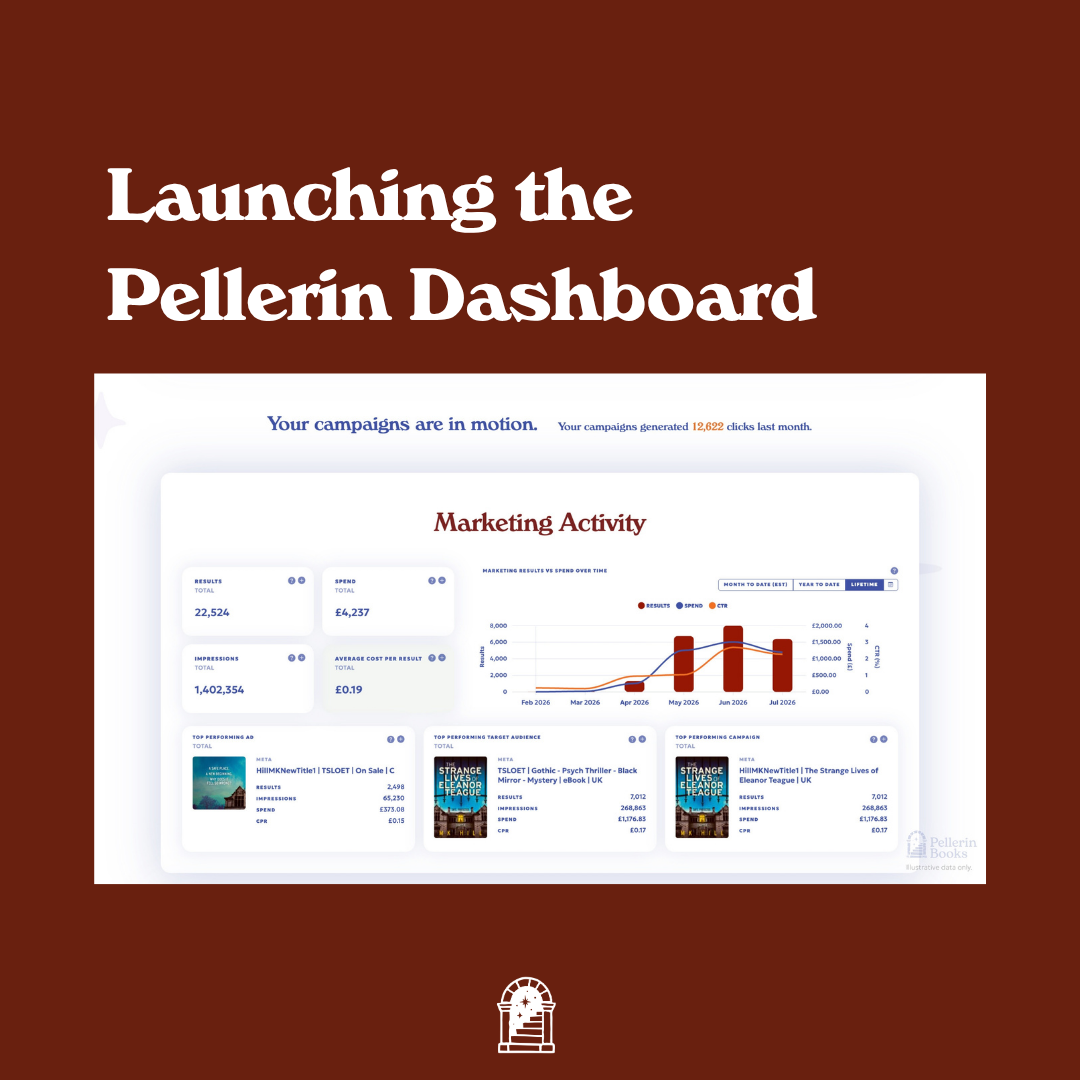
The Pellerin Dashboard was designed to change that.
The platform gives authors direct access to their sales and marketing performance data, allowing them to see how their books are performing across territories, formats and channels. More importantly, it enables them to understand the relationship between the activity happening around their books and the results being generated. Authors can see not just what is happening, but why it is happening.
For many traditionally published authors, this level of visibility is unprecedented. Yet it has long been standard practice within self-publishing, where authors have direct access to digital retailer dashboards and real-time performance metrics. As Jessie explained during the conversation, increasing numbers of authors are attracted to self-publishing not because they want to lose the support of a publisher, but because they want greater access to information about their own careers.
Pellerin’s ambition is to combine the strengths of both worlds. Authors receive the editorial, production, marketing and distribution support associated with traditional publishing, while retaining access to the data and insights typically available only to self-published authors.
As Jessie summarised:
“We’re giving the data of a self-published author with the resource and backing of a traditional publisher. We’re trying to exist in that kind of middle section and evolve that relationship between authors and publishers.”
In many ways, that ambition captures the wider philosophy behind Pellerin itself: combining the best elements of traditional publishing with the transparency and agility that modern authors increasingly expect.
For Pellerin, transparency isn’t simply a feature. It’s a reflection of a broader belief that better information leads to better decisions, stronger partnerships and ultimately better outcomes for authors.
Throughout the conversation, Laura and Jessie returned repeatedly to the same idea: publishing’s challenges are not caused by a lack of passion, expertise or good intentions.
In fact, the opposite is often true. Publishing is chock-full of talented people who care deeply about books, authors and readers. The problem is that many of the systems the industry still relies upon were built for a very different world – one defined by limited shelf space, limited discoverability and limited routes to readers.
For decades, those systems made sense. Publishers had to work within the constraints of physical retail. Success was often determined by a handful of influential gatekeepers. Marketing activity was concentrated around publication because books had a relatively short window in which to prove themselves.
But the world has changed. Readers discover books differently. Authors build audiences differently. Marketing works differently.
The question, Laura and Jessie argue, is whether publishing is willing to change too. Throughout the episode, they outlined what that evolution might look like: moving beyond short-term launch windows, embracing long-term discoverability, understanding the role of modern gatekeepers and algorithms, treating authors as genuine partners, and creating greater transparency around the decisions that shape author careers.
For Pellerin, those ideas aren’t simply talking points. They’re already shaping everything the company does – from guaranteed marketing investment and long-term discoverability strategies to radical transparency and author partnership.
Want to hear the full conversation? Listen to Laura Palmer and Jessie Sullivan’s full conversation on the Great Women Podcast wherever you get your podcasts.